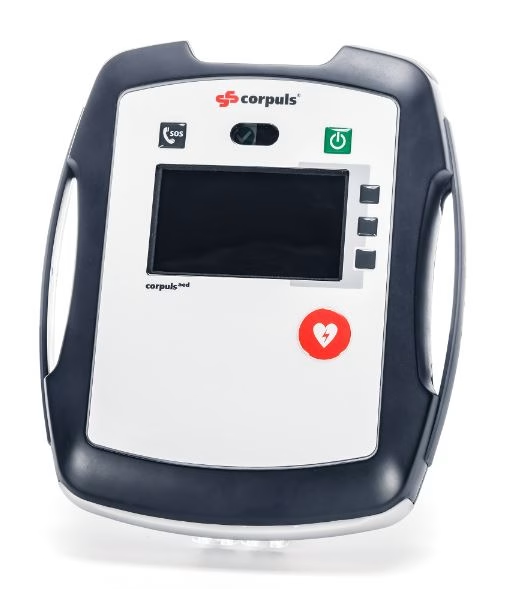
With the ECGmax you not only get the usual 12-lead ECG, but 22 leads which is a much more comprehensive picture of the heart muscle including the posterior wall and the right side.
Over 20 years ago, corpuls brought the 12-lead ECG to the emergency services and it has been the gold standard in ECG diagnostics ever since. Until now.
In 2020 corpuls revolutionised the ECG again: With the ECGmax you not only get the usual 12, but 22 leads and thus a much more comprehensive picture of the heart muscle including the posterior wall and the right side. The current European Society of Cardiology guidelines recommend that these be examined if possible. No additional effort is required and no electrodes have to be attached or positioned.
Broadened diagnostics with 22 leads
Posterior leads V7–V9
Right cardiac leads V3r–V6r
Orthogonal leads X, Y, Z and Vectorloops
Only 10 electrodes, extremities and chest leads
CEB® – The cardiac electrical biomarker
In addition, ECGmax can calculate the Cardiac Electrical Biomarker CEB® from the same electrodes. The three colour-coded areas of the CEB® – normal, conspicuous, abnormal – make interpretation particularly easy. The user can immediately recognise whether myocardial ischemia is present – with comparable sensitivity and specificity to troponin.
Simple interpretation using the traffic light concept
Measured value is comparable to troponin
Fast reaction by measuring the electric field
High sensitivity and specificity
No additional electrodes required
Continuous value
Non-invasive measurement
Vectorloops
Vectorloops according to Frank, consider the electrical conduction in the heart as a rotating dipole. The course of the peak of this vector is spatially represented as a loop in a three-dimensional individual coordinate system.
The loops correspond to the P wave, the QRS complex and the T wave. With a healthy myocardium, the loops are regular and “fluid looking”, with a dysfunction the conduction of the dipole is rather irregular and jagged.
Electrical conduction as a rotating dipole
Represented as a loop in the 3D coordinate system
Loops correspond to the P wave, the QRS complex and the T wave
Healthy loops are more regular and “flowing”
Dysfunction shows as irregular and jagged